25 7月 2023

フランスにおけるAPIXABAN事件:特許権者の優先


英国の同僚が、本件における英国の判決について、すでにもっともらしさ(plausibility)の観点から見事な評釈を行っています(こちらを参照)。私としては、英国の判決とは反対の立場をとった、同じ事件におけるフランスの判決について論評したいと思います。以下に見るとおり、フランスの立場は、とりわけもっともらしさ(plausibility)の概念と優先権の解釈を通じて、特に特許権者に有利なものとなっています。

事実関係

特許EP1427415(以下「EP’415」)は、2001年9月21日付の米国仮出願US 60/324,165に基づく優先権を主張して、2002年9月17日に国際出願PCT/US02/29491(WO 03/026652)(以下「WO’652」)の形式で、Bristol-Myers Squibb Company(以下「BMS Company」)の名義により出願されました。同特許は2022年9月17日に存続期間が満了しており、2026年5月20日に満了する補充的保護証明書(SPC)FR11C0042の基礎となっています。

EP’415は、アピキサバン(請求項1及び2)、これを含む医薬組成物(請求項3及び4)、治療に使用するための当該化合物及び医薬組成物、特に血栓塞栓性疾患の治療のためのもの(請求項5から22)、さらに任意で、血栓溶解性疾患を治療するための第二の治療薬と組み合わせたもの(請求項23から29)を請求しています。

アピキサバン(1-(4-methoxyphenyl)-7-oxo-6-[4-(2-oxopiperidin-1-yl)phenyl]-4,5,6,7-tetrahydro-1H-pyrazolo[3,4-c]pyridin-3-carbamide)

本特許に対して異議申立ては行われていません。しかし、世界各地で複数の無効手続が提起されています。例えば、カナダ特許(CA2461202)の有効性は複数の理由で争われましたが、いずれも認められませんでした(Federal Court judgment of January 12, 2021, in BMS v. Pharmascience & Sandoz)。さらに、SandozとTevaは、特に国際公開WO 00/39131に照らした進歩性の欠如、もっともらしさ(plausibility)の欠如、及び出願時の内容を超える拡張を理由として、本出願の英国部分について無効宣言を申し立てました。原告は特許の無効を勝ち取りました。Arnold判事は、アピキサバンの構造に基づく理論も、明細書に例として記載されたデータも存在しない以上、出願中のいかなる記載も、アピキサバンが第Xa因子阻害剤であるという主張を裏付けていないと判断したのです。したがって、当該主張はもっともらしいとはいえません。出願は、当業者チームに対して、その主張が真実であると判明する合理的な見込みがあると信じる理由を何ら与えていないからです。

フランス判決の内容

英国の裁判官とは異なり、パリ司法裁判所は、進歩性の評価の枠組みにおいて、アピキサバンが第Xa因子阻害剤であるという主張はもっともらしいと判断しました。

本件において、当初の出願には、上記で引用した段落[00028]も段落[00180]も含まれておらず、これらは審査段階の2008年、すなわち優先日よりかなり後に追加されたものでした。同様に、請求項も全面的に書き直されています。当初の請求項は、中心構造の周囲にある各種置換基の可能な変形に基づき、非常に多数の化合物(74)について保護を求めていました。このことから、出願人は出願時に発明を保有しておらず、着想や直感に基づいて出願したと推論することもできたでしょう。しかし裁判所は、当初のWO’652出願がアピキサバンを具体的に開示しており、さらに実施例(第18号)として例示していることを指摘します。確かにそれは、140の実施例と100を超える化合物の合成の記載の中の一つにすぎません。そうであるとしても、裁判所は、このWO’652文書が試験を開示しており、その結果、非常に良好な親和性、特にKi # 0.001 μMを有する「最も好ましい」化合物が特定されていることを指摘します。WO’652はさらに、本発明が、改善された薬理学的及び薬物動態学的特性を有する第Xa因子阻害剤に関するものであると述べています。また、3.07 gのアピキサバンが合成されたことも記載されています(178頁)。この量は、明細書によれば群を抜いて最大の合成量であるという点で、アピキサバンを他のすべての合成化合物の実施例から疑いなく区別するものです(1グラムに達する実施例は他になく、次に多い合成量は実施例91の0.34 gです)。当業者であれば、技術常識に基づき、特許権者がアピキサバンを有望な化合物、さらには最も有望な化合物と考えていたことを必然的に推論したはずです。

さらに、BMSは、WO’652出願より前に作成された研究者の実験ノート及び報告書を提出しました。これらは、BMSが発明、すなわち血栓塞栓性疾患の治療に有用で、改善された薬理学的及び薬物動態学的特性を有する第Xa因子阻害剤を保有していたことを争う余地なく証明するものであり、しかも真剣に争われてもいません。これらの要素は、BMSが説明した研究計画、及び優先日前にPinto博士とその同僚がアピキサバンを発見したことを完全に裏付けています。

裁判所は、出願時におけるEP’415の先行技術への貢献の「もっともらしさ」又は「信憑性」の欠如、ひいては請求項1から4の進歩性の欠如を主張する抗弁は、したがって退けられると結論づけました。

さらに、優先権に関して、裁判所は次のように指摘します。BMS Pharma(WO’652を出願したBMS Companyではありません)の資産であった仮出願US 60/324,165に由来する優先権の譲渡は、原則として、2001年11月3日(発明者がBMS Pharmaに発明を譲渡した日)からPCT出願の出願日である2002年9月17日までの間に、書面によりBMS Companyに対して行われるべきでした。そうして初めて、BMS Companyはパリ条約の意味におけるBMS Pharmaの承継人とみなされ、優先権を有効に行使したとみなされ得たのです。

しかし、フランスの裁判官は、Holland判事の陳述に言及しています。同判事は、会社間の厳格な区別に関するこの「二元的」な結論に留保を付け、一定の場合には、デラウェア州法(BMS PharmaとBMS Companyはいずれも同州で設立されています)が「法人格のヴェールを引き上げる」ことを認めていると述べており、これは証明書によるもので、Chandler判事の証言によっても確認されています。本件では、BMS PharmaはBMS Companyの完全子会社であり、特許ポートフォリオの管理はもっぱらBMS Companyがその単独の利益において決定していました。その結果、裁判所は、優先権は書面なしに譲渡されていたと判断しました。

フランス判決の射程

私見では、本判決の二つの側面、すなわちもっともらしさと優先権が特に興味深いと考えます。

フランスの判例には、もっともらしさの概念を適用した例が数多くあります。例えば、発明は出願日において「信憑性のある」又は「もっともらしい」技術的効果を有していなければならず、その欠如は進歩性の欠如を理由として制裁されると、すでに判示されています(例えば、TGI Paris, October 6, 2009, RG n°07/16446, Teva v. Sepracor)。また、技術的効果の信憑性は、優先日又は出願日において(例えば、TGI Paris, October 6, 2009, RG n°07/16446, Teva v. Sepracor)、特許権者の主張を含む出願中の要素に照らして評価され、特許権者は出願において試験や治験の結果その他のデータを提供する義務を負わないとも判示されています(例えば、CA Paris, October 29, 2020, RG n°126/2019, Ethypharm v. Merck Sharp & Dohme Corp)。出願後の要素も考慮され得ますが、技術的効果の信憑性を証明する唯一の根拠とすることはできません(例えば、TGI Paris, October 6, 2009, RG n°07/16446, Teva v. Sepracor)。

本判決は、技術的効果は試験やデータの提供を要することなくもっともらしいものであり得ることを明確にしています。これはまさに、英国でArnold判事が判断したことの正反対です。しかし、この柔軟性は欧州特許庁(EPO)拡大審判部のG 2/21決定に沿うものです。それは当初からの(ab initio)非もっともらしさの承認であるように思われます。すなわち、出願日後の証拠は、当業者が出願日において技術的効果が得られることを疑う正当な理由を有していた場合にのみ考慮から除外され得るということです(例えば、T919/15, T578/06, T2015/20)。裁判所はさらに、当業者が発明を理解し、それが「もっともらしい」(かつ十分に開示されている)とみなされるよう、特許権者は特に試験によって請求された新たな効果を記載することが期待されるものの、それは特許が物質又は組成物のその後の治療用途に関する場合に限られると明示しています(例えば、Cass. Com., December 6, 2017, n° 15-19.726)。

優先権の譲渡に関しては、判例によれば、最初の出願の譲渡は当然に優先権の譲渡を伴うものではありません。破毀院によれば、優先権は「最初の特許出願によって付与される権利とは別個かつ独立の権利」を構成します。そのため、この権利の譲渡には特許譲渡契約に明示の条項を含めることが必要であり、「一切の留保又は例外なく、これに付随するすべての権利とともに」という単なる記載から生じることはありません。この点についてパリ司法裁判所が採用した立場は、もっともらしさに関する判示の陰にやや隠れているものの、重要であり、従来の判例と矛盾するものです。

若干の考察

第一に、もっともらしさに関して、本件では、国際出願WO 00/39131がアピキサバンに構造的に近い化合物(例えば、G = 4-(methoxy)phenylの場合に207頁の表Iの第一の一般式に当てはめた240頁の化合物1041から1053を参照)に関するものであり、それらが血栓塞栓性疾患の治療に有用な第Xa因子阻害剤として提示されていたことを想起すべきです。したがって、この出願は、課題解決アプローチの適用に適した最も近い先行技術を構成します。アピキサバンとWO 00/39131に記載された化合物との構造上の相違には、特段の技術的効果は結び付けられていませんでした。したがって、客観的技術課題は、国際出願WO 00/39131に記載されたものの代替として、血栓塞栓性疾患の治療に有用な第Xa因子阻害剤を見出すことと定式化し得たのです。当該化合物、特にアピキサバンが治療効果の基礎となる効果を有することを示す実験データは、特許中に何ら示されていませんでした。

本件においてもっともらしさを認めることにより、第一審裁判所はもっともらしさについて柔軟な解釈を採用しています。こうして本判決はEPOのG 2/21決定に沿うものですが、それはab initioの非もっともらしさという、より有利な立場を採用することによるものであり、他方で英国の裁判官の解釈とは相反する解釈を示しています。英国の裁判官は試験とデータが必須であると考えるのに対し、フランスの裁判官は逆に、その後の治療用途という特定の場合を除き、それらは必須ではないと考えているのです。

この立場は、もっともらしさの基準を特に低い水準に設定する傾向にあり、それが特許権者にとって有利であることは疑いありません。それ自体として、この解釈は一般的な傾向の一部をなす限りにおいて衝撃的なものではありません。しかし、ある判決が一般的な傾向に沿っているからといって、それに賛同すべきことにはなりません。本件において、もっともらしさの活用は、請求された発明によって達成される結果の偶然性に特徴づけられる分野、すなわち医薬分野において、特許性の評価を容易にすることを意図しているように私には思われます。しかし、それ自体すでに本質的に出願人に有利なこの基準の評価を、過度に引き下げることには慎重であるべきです。そうでなければ、技術の領域というよりむしろ研究の領域に属する傾向のある発明の実施を自らに留保し得る出願人に、不当な利益を与えることになります。要するに、もっともらしさが否定されるのは、当業者が出願時に疑う正当な理由を有していた場合に限られることになり、その結果、出願人は、まだ着手すらしていない研究分野全体を自らのものとして請求できることになるのです。

また、裁判所が技術的貢献、具体的結果及び技術的結果を混同していることにも留意すべきです。技術的貢献は技術的効果にあるのではなく、先行技術に対する発明の貢献にあります。技術的結果は具体的結果と区別し得るものです。もっとも、私自身はこの点を非常に深く疑っていますが、いずれにせよ、本件において技術的結果を特徴づけるものが何であるかを明らかにする必要があったはずであり、裁判所は本件においてそれを行っていません。

優先権に関しては、私はより強い驚きと批判を覚えます。ここでも、採用された立場は特許権者、とりわけ優先権の譲渡がないことに起因する数多くの困難に直面している米国の特許権者にとって(非常に)有利なものです。外観理論(すなわち、子会社が特許権者のように振る舞うこと)に基づく実際的な解釈は興味深いものですが、それは、優先権が単に適切に譲渡されていなかったという事実を覆い隠すための数多くの混同の産物です。実際、特許の承継は必ずしも優先権の承継を意味しません。優先権は独立して譲渡され得るからです。また、ある会社がグループに属しているという事実は、そのすべての資産が親会社に移転されなければならないことを意味しません。そして、last but not least、本件のように、優先権が一度も譲渡されていないため権利の連鎖が当初から断絶している場合、その後のいかなる行為がどのようにしてその状況を是正し得るのか、私には理解し難いところです。最後に、外観理論(すなわち、他者に対して所有者のように振る舞うことで、財産権の所有者の外観が生じること)は容易に理解できるものの、何らの権利も譲渡されていない別会社である子会社が、親会社と同様にこの理論の恩恵を受け得るとは、なかなか考え難いところです。残念ながら、これは特許権者に対し優先権の譲渡を適切に形式化するよう促すものではなく、特許制度全体を見渡すならば、賛同することはできません。形式主義は、この制度の利用者を煩わせるため(だけ)に存在するのではなく、制度が正しく機能し、本件においては誰が権利者であるかを明確に示すことができるようにするためにも存在するのです。

結論として、本判決が特許権者に有利なものであること、統一特許裁判所(UPC)の幕開けにあたり、フランスの裁判官が今後も、そしておそらくこれまで以上に発言権を持ち続けることを想起させていること、そしてフランスで数年来進行しているこの傾向がすぐに途絶える可能性は低いことには、ほとんど疑いの余地がありません。Cour de Cassationが、この秋、パリTribunal Judiciaireの最も卓越した特許法の専門家を迎え入れるからです。

The facts

Patent EP1427415 (“EP’415″) was filed in the name of Bristol-Myers Squibb Company (“BMS Company”) on September 17, 2002 in the form of international application PCT/US02/29491 (WO 03/026652) (“WO’652”), under the priority of provisional application US 60/324,165 of September 21, 2001. It expired on September 17, 2022 and forms the basis of SPC FR11C0042, which will expire on May 20, 2026.

EP’415 claims apixaban (claims 1 and 2), the pharmaceutical composition comprising it (claims 3 and 4), the compound and the pharmaceutical composition for use in therapy, in particular to treat thromboembolic disorders (claims 5 to 22), optionally in association with a second therapeutic agent to treat thrombolytic disorders (claims 23 to 29).
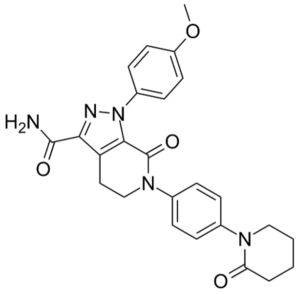
 

Apixaban (1-(4-methoxyphenyl)-7-oxo-6-[4-(2-oxopiperidin-1-yl)phenyl]-4,5,6,7-tetrahydro-1H-pyrazolo[3,4-c]pyridin-3-carbamide)

The patent is unopposed. However, several invalidity proceedings have been initiated worldwide. For example, the validity of the Canadian patent (CA2461202) has been challenged on several grounds, but without success (Federal Court judgment of January 12, 2021, in BMS v. Pharmascience & Sandoz). In addition, Sandoz and Teva applied for a declaration of invalidity of the UK part of the application on the grounds of lack of inventive step, in particular in view of the international publication WO 00/39131, lack of plausibility and extension beyond the content of the application as filed. The plaintiff obtained the revocation of the patent, Judge Arnold having found that, in the absence of any theory based on the structure of apixaban or of any data appearing in the description, by way of example, nothing in the application supports the assertion that apixaban is a factor Xa inhibitor. As such, the assertion is not plausible, because the application gives the skilled team no reason to believe that there is a reasonable prospect that the assertion will turn out to be true.


The content of the French decision

Unlike the British judge, the Paris Court decided that the claim that apixaban is a factor Xa inhibitor was plausible in the frame of inventive step assessment.

In the present case, the initial application contained neither paragraph [00028] nor paragraph [00180], cited above, which were added during the examination phase in 2008, i.e., well after the priority date; similarly, the claims were completely recast: they initially claimed protection for a very large number of compounds (74) based on the possible variants of the various substituents around the central structure. It could be deduced from this that the applicant was not in possession of the invention at the time of filing, and that it filed on the basis of an idea or an intuition. The Court notes, however, that the initial WO’652 filing specifically discloses apixaban, which is further exemplified (no. 18), admittedly among 140 examples and the description of more than 100 product syntheses. This being the case, the court notes that this WO’652 document reveals tests, resulting in the determination of “most preferred” compounds with very good affinity and in particular a Ki # 0.001 μM. WO’652 further states that the invention relates to a factor Xa inhibitor with improved pharmacological and pharmacokinetic properties. It also describes that 3.07 g of apixaban have been synthesized (page 178). This quantity unquestionably distinguishes apixaban from all other examples of synthesized compounds, in that it is by far the largest quantity synthesized according to the description (no other example reaches one gram, the other largest quantity synthesized being example 91: 0.34 g). A person skilled in the art would necessarily have deduced, on the basis of common general knowledge, that the patentee thought apixaban was a promising compound, if not the most promising.

In addition, BMS has submitted laboratory notebooks and reports from its researchers, prior to the filing of the WO’652 application, which demonstrate indisputably, and moreover not seriously disputed, that it was in possession of the invention, i.e., a factor Xa inhibitor, useful in the treatment of thromboembolic disorders, with improved pharmacological and pharmacokinetic properties. These elements fully confirm the research program as outlined by BMS, and the discovery of apixaban by Dr. Pinto and his colleagues before the priority date.

The Court deduced that the plea alleging the lack of “plausibility” or “credibility” of EP’415’s contribution to the state of the art at the time of filing, and hence the lack of inventive step of claims 1 to 4, was therefore rejected.

Furthermore, with regard to the priority right, the Court points out that the assignment of the priority right stemming from provisional application US 60/324,165, which was an asset of BMS Pharma (and not of BMS Company which filed WO’652), should in principle have been made in writing between November 3, 2001 (the date on which the inventors assigned their invention to BMS Pharma) and September 17, 2002, date of filing of the PCT application, to BMS Company, for the latter (BMS Company) to be considered the successor in title of the former (BMS Pharma) within the meaning of the Paris Convention, so that the latter could be considered to have validly exercised the priority right.

However, the French Judge refers to a statement made by Judge Holland, which nuances this “binary” conclusion on the strict distinction between companies, stating that in certain hypotheses, the law of the State of Delaware (in which both BMS Pharma and BMS Company are incorporated) allows “the corporate veil to be lifted”, which results from an attestation, and is confirmed by Judge Chandler’s testimony. In this case, BMS Pharma was a wholly owned subsidiary of BMS Company, so the management of the patent portfolio was entirely decided by BMS Company in its sole interest, with the result that the Court ruled that the priority right had been assigned without a written document.

The scope of the French decision

In my view, two aspects of judgment are particularly interesting: plausibility and priority.

French case law contains numerous examples of the application of the notion of plausibility. For example, it has already been ruled that an invention must have a “credible” or “plausible” technical effect at the date of filing, and its absence is sanctioned on the grounds of lack of inventive step (e.g., TGI Paris, October 6, 2009, RG n°07/16446, Teva v. Sepracor). Or that the credibility of the technical effect is assessed at the priority or filing date (e.g., TGI Paris, October 6, 2009, RG n°07/16446, Teva v. Sepracor), in the light of the elements contained in the application, including the patentee’s assertions, without the latter being obliged to provide in the application the results of tests or trials or any other data (e.g., CA Paris, October 29, 2020, RG n°126/2019, Ethypharm v. Merck Sharp & Dohme Corp). Post-filing elements may also be taken into consideration but cannot serve as the sole basis for demonstrating the credibility of the technical effect (e.g., TGI Paris, October 6, 2009, RG n°07/16446, Teva v. Sepracor).

The decision clarifies that a technical effect may be plausible without requiring the provision of tests or data; this is precisely the opposite of what was decided by Judge Arnold in the United Kingdom. But this flexibility is in line with decision G 2/21 of the EPO’s Enlarged Board of Appeal: it seems to be a recognition of ab initio implausibility, i.e., that evidence subsequent to the filing date can only be disregarded if the person skilled in the art had legitimate reasons to doubt that the technical effect could be obtained at the filing date (e.g., T919/15, T578/06, T2015/20). The court further specifies that the patentee is expected to describe the claimed new effect by means of tests, in particular, so that the person skilled in the art understands the invention and it is considered “plausible” (and sufficiently described), but only if the patent relates to a subsequent therapeutic application of a substance or composition (e.g., Cass. Com., December 6, 2017, n° 15-19.726).

With regard to the assignment of priority rights, according to case law, assignment of the initial application does not automatically entail assignment of the priority right. According to the French Supreme Court, the priority right constitutes “a right distinct and independent from that conferred by the first patent application“. As such, the assignment of this right requires the inclusion of an express clause in the patent assignment contract and cannot result from the simple mention “with all the rights attached thereto without any reservation or exception“. The position adopted on this point by the Paris court, while somewhat overshadowed by the contribution on plausibility, is nonetheless important and in contradiction with previous case law.

A few comments

Firstly, with regard to plausibility, in the present case, it should be remembered that international application WO 00/39131 concerned compounds structurally close to apixaban (see for example compounds 1041 to 1053 on page 240 applied to the first general formula in Table I on page 207 when G = 4-(methoxy)phenyl) presented as factor Xa inhibitors useful for the treatment of thromboembolic disorders. This application therefore constitutes the closest state of the art suitable for the application of the problem-solution approach. No particular technical effects were associated with the structural difference between apixaban, and the compounds described in WO 00/39131. The objective technical problem could therefore be formulated as finding a useful factor Xa inhibitor for the treatment of thromboembolic disorders, as an alternative to those described in the international application WO 00/39131. No experimental data had been presented in the patent showing that the compounds in question, and apixaban in particular, would have an effect underlying a therapeutic effect.

By recognizing plausibility in this case, the Court of First Instance adopts a flexible interpretation of plausibility. While it is thus in line with the EPO’s G 2/21 decision, by adopting the more favorable position of ab initio implausibility, it nevertheless gives an interpretation opposed to that of the English judge. While the latter considers that tests and data are compulsory, the French judge considers, conversely, that they are not compulsory, except in the specific case of subsequent therapeutic application.

This position thus tends to set the threshold of plausibility at a particularly low level, which is undoubtedly favorable to the patentee. In itself, this reading is not shocking in that it is part of a general trend. But just because a decision is part of a general trend doesn’t mean it should be approved. In this case, it seems to me that the use of plausibility is intended to facilitate the assessment of patentability in a field marked by the randomness of the results achieved by claimed inventions: the pharmaceutical field. However, we must remain cautious about lowering the assessment of this criterion, which is already intrinsically favorable to applicants, too far. To do otherwise would be to give an undue advantage to an applicant who could reserve for himself the exploitation of an invention that tends to fall more within the domain of research than that of technology. So, to sum up, plausibility will only be ruled out if the person skilled in the art had legitimate reasons for doubt at the time of filing, so that the applicants can claim an entire field of research for themselves, without having yet begun to work on it.

It should also be noted that the Court confuses technical contribution, concrete result and technical result. The technical contribution does not lie in a technical effect, but in the invention’s contribution to the state of the art. The technical result can be distinguished from the concrete result, although I personally doubt this very seriously, but it would still be necessary to specify in this case what characterizes the technical result, which the Court did not do in this case.

As far as the priority right is concerned, I remain more astonished and critical. Here again, the position adopted is (very) favorable to the patentee, and in particular to American patentees, who are experiencing numerous difficulties linked to the absence of assignment of the priority right. The pragmatic interpretation adopted, which is based on the theory of appearance (i.e., the subsidiary behaves like the patent owner) is interesting, but it is the result of numerous confusions designed to conceal the fact that the priority right has simply not been properly assigned. In fact, taking over patents does not necessarily imply taking over priority rights, since these can be assigned independently. And the fact that a company belongs to a group does not mean that all its assets have to be transferred to its parent company. Finally, last but not least, when a chain of rights is broken from the outset, as is the case here, since the priority right has never been assigned, I find it hard to see how any subsequent acts could remedy the situation. Finally, while I can easily understand the theory of appearance (i.e., behaving like an owner towards others gives me the appearance of the owner of the property right), I have more difficulty conceiving that the subsidiary, which is a separate company to which no rights have been assigned, can also, like the mother, benefit from this theory. Unfortunately, this does not encourage patentees to properly formalize their assignments of priority rights, which cannot be approved if we look at the patent system as a whole. Formalism is not (only) there to annoy the users of this system, but also to ensure that it functions correctly and can, in this case, clearly indicate who the right holder is.

In conclusion, there can be little doubt that this decision is favorable to patentees, that at the dawn of the UPC, French judges are reminding us that they will still, and perhaps more than ever, have their say, and that this trend, which has been underway for several years in France, is not likely to die out any time soon, because the Cour de Cassation will be welcoming the most eminent patent law specialist from the Paris Tribunal Judiciaire to its midst this autumn.

Auteur : Dhenne Avocats.