
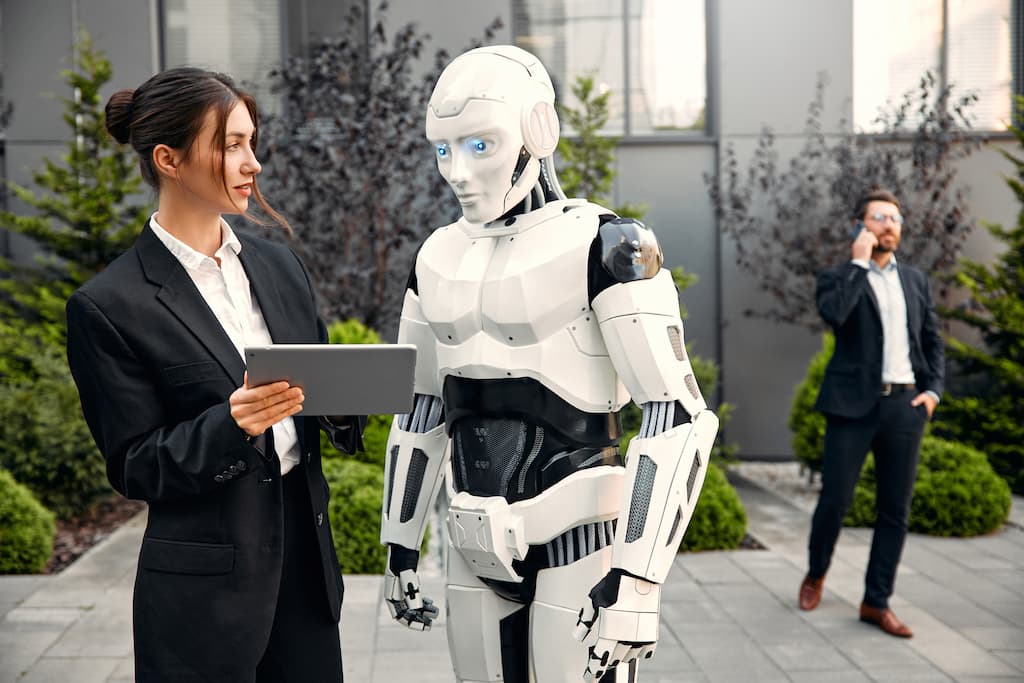
Le 17 septembre 2019, une demande de brevet inhabituelle est déposée simultanément dans plusieurs juridictions mondiales. Pour la première fois dans l’histoire du droit des brevets, l’inventeur désigné n’est pas un être humain, mais une intelligence artificielle baptisée DABUS. Cette démarche audacieuse du Dr Stephen Thaler allait déclencher une bataille juridique internationale qui questionne les fondements mêmes de notre conception de l’invention.
DABUS: an AI that claims to invent
DABUS, an acronym for «Device for the Autonomous Bootstrapping of Unified Sentience,» is an artificial intelligence system developed by Stephen Thaler, an American researcher specialising in artificial neural networks. Unlike traditional AIs that perform pre-programmed tasks, DABUS simulates the human brainstorming process to generate new ideas.
The two inventions claimed by DABUS illustrate this supposed creative capacity: a food container based on fractal geometry, designed to optimise heat retention, and a «neural flame», a lighting device that imitates brain activity to attract attention in emergencies. These inventions, according to Thaler, were generated autonomously by the AI, without direct human intervention in the creative process.
A global legal strategy: testing the limits of the law
Thaler's initiative is part of the Artificial Inventor Project, a collaborative project involving academics and intellectual property law specialists. The stated aim is to test the ability of existing legal systems to recognise inventions generated by artificial intelligence.
The strategy adopted is to simultaneously file patent applications in a dozen jurisdictions, systematically naming DABUS as the inventor. This coordinated approach aims to create international pressure and identify loopholes or openings in the various national patent systems.
The near-unanimous rejection of patent offices
United States: the USPTO closes the door
The United States Patent and Trademark Office (USPTO) categorically rejects applications in April 2020. The American office relies on a strict interpretation of federal patent law, which defines an inventor as an «individual» or group of 'individuals.» This position reflects an anthropocentric conception of invention, rooted in American legal tradition.
Europe: EPO confirms human requirement
The European Patent OfficeEPO) adopte une position similaire, rejetant les demandes en décembre 2019. La décision J 8/20 de la Chambre de recours, rendue le 21 décembre 2021, confirme ce rejet en analysant minutieusement la Convention sur le European patent. Les juges concluent que l’inventeur désigné doit nécessairement être une personne physique disposant de la capacité juridique, excluant de facto toute entité artificielle.
United Kingdom: From the Patent Court to the Supreme Court
In the UK, the case has followed a complete legal route. The Intellectual Property Office (IPO) initially rejected the applications in November 2019. Judge Marcus Smith of the Patent Court upheld this rejection on 21 September 2020, ruling that the Patents Act of 1977 requires the inventor to be a natural person. The Court of Appeal maintained this position in September 2021, and the UK Supreme Court finally refused to hear the case in December 2023, definitively sealing DABUS's fate on this side of the Channel.
The Australian exception: a spectacular reversal
Australia offers the most fascinating case study in this legal saga. On 30 July 2021, in the case of Thaler v Commissioner of Patents [2021] FCA 879, Justice Jonathan Beach of the Federal Court of Australia delivered a landmark decision. Unlike his international counterparts, he found that nothing in the Australian Patents Act explicitly required the inventor to be a human being.
Judge Beach adopts an evolving interpretation of the law, holding that «an inventor can be an artificial intelligence» and that «inventions made by artificial intelligence are patentable in Australia». This decision has caused a stir in the international legal community and temporarily places Australia in a pioneering position.
However, this victory is short-lived. IP Australia immediately appeals, and the Full Federal Court overturns the decision on 13 April 2022 in the judgment Commissioner of Patents v Thaler [2022] FCAFC 62. The three appeal judges unanimously conclude that an inventor must possess legal standing, an exclusively human attribute. The High Court of Australia ultimately refuses to hear the appeal in November 2022.
South Africa: The Only Success
Only South Africa ultimately grants a patent to DABUS in July 2021. This decision, taken by the South African Intellectual Property Office (CIPC), constitutes a world first. However, this victory must be put into perspective: the South African patent system operates on a principle of automatic registration, without prior substantive examination. The validity of this patent could therefore be challenged in the South African courts.
The fundamental legal issues revealed
The DABUS case highlights several crucial questions for the future of patent law:
- The definition of inventor Are current legal texts, written in a pre-AI era, suitable for contemporary technological realities?
- The allocation of rights If an AI can invent, who holds the economic rights to the invention? The programmer, the user, the owner of the AI?
- Encouraging innovation The patent system aims to reward human creative effort. Does this logic remain relevant for artificial creations?
The repercussions for the innovation ecosystem
Beyond purely legal considerations, the DABUS case raises major economic issues. Companies are investing heavily in generative AI, and legal uncertainty over the patentability of their innovations could curb these investments. Paradoxically, too broad a recognition of AIs as inventors could also devalue human innovation and create an inflation of artificial patents.
The necessary evolution of legal frameworks
Faced with these challenges, several avenues for development are emerging. The World Intellectual Property Organization (WIPO) is currently conducting international consultations on AI and intellectual property. The discussions focus in particular on the creation of a hybrid legal status for AI creations, or on the adaptation of traditional patentability criteria.
Some experts are proposing a two-tier system: maintaining the requirement for a human inventor for traditional patents, while creating a specific regime for AI-assisted or AI-generated inventions, with a reduced protection period and clarified attribution conditions.
DABUS's legacy in contemporary law
Although DABUS has not succeeded in being recognised as an inventor in the majority of jurisdictions, its impact on patent law is undeniable. The case has forced legislators, legal professionals and patent offices to confront their anthropocentric assumptions with the reality of artificial innovation.
She also revealed the limitations of purely textual interpretations of law in the face of technological advancements. The decisions made in this case will serve as precedents for future issues related to AI and intellectual property, establishing a body of case law that will guide the evolution of law in this field.
The DABUS case thus marks a turning point in the history of patent law, not through its successes, but through the fundamental questions it has raised and the debates it continues to fuel within the international legal community.
Further reading